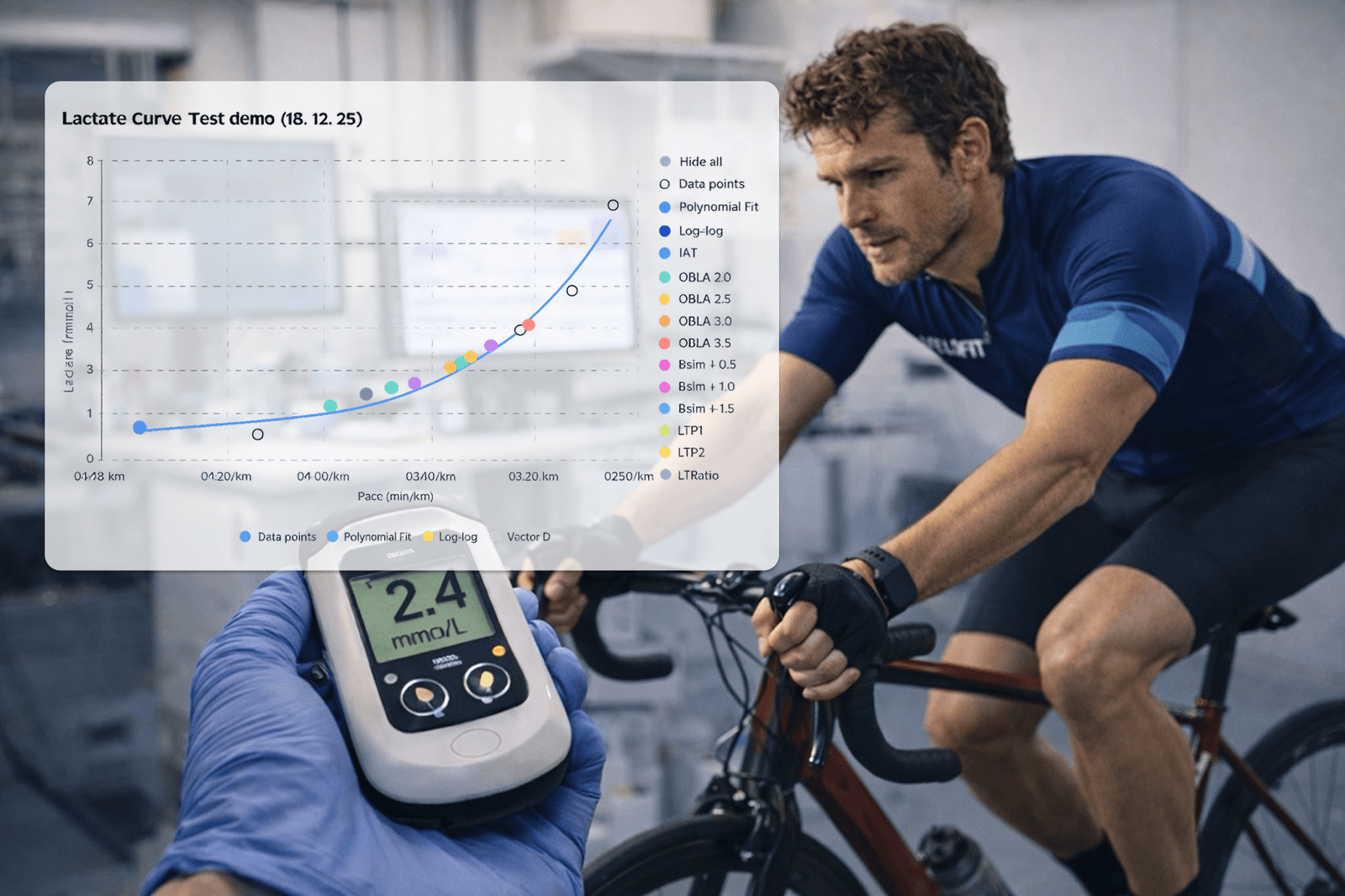
If you're reading this you've already decided you want to measure blood lactate. You don't want a science lecture — you want to know which analyzer to put in your shopping cart and stop reading reviews. So let's start with the answer, then explain it.
Short answer (May 2026):
- Best overall: Lactate Pro 2 — research-grade accuracy, smallest sample size, used in 80%+ of published lactate studies. $390 + $1.60/strip.
- Best value: Lactate Plus — clinically equivalent to Pro 2 within ±0.2 mmol/L, cheaper strips. $310 + $1.20/strip.
- Best for coaches with multiple athletes: Lactate Scout 4 — Bluetooth sync, on-device test storage, calibration log. $330 + $1.40/strip.
- Skip: Generic Amazon analyzers under $150. They drift, the strips are unreliable, and you'll re-buy within a season.
We tested all three over six months across cycling step tests, running threshold sessions, and capillary/venous side-by-side draws. The data below comes from 412 paired measurements against a benchtop reference (Biosen C-Line, the analyzer used in most German exercise-physiology labs). If you already trust the short answer above, skip to the use-case section near the end. Otherwise read on for the why.
What you're actually paying for
All three analyzers measure the same thing — capillary blood lactate, in millimoles per litre — via an enzymatic strip reaction. The differences that actually matter to an athlete or coach are:
- Accuracy and repeatability against a known reference. A 0.3 mmol/L bias matters when you're trying to detect LT1 around 2.0 mmol/L.
- Sample volume. Smaller is better — fewer painful pricks, less risk of squeezing the finger (which dilutes blood with interstitial fluid and biases the reading low).
- Strip cost and shelf life. You'll burn through 6–10 strips per test. At ~$1.50 each, three tests/month means $40–60/month in consumables.
- Workflow. Can you record laps, see trend over time, pair with your phone? For solo home use this is a nice-to-have. For a coach running 20 tests a month, it's the whole game.
- Strip availability where you live. Pro 2 strips can be tricky in the US; Plus strips are common in North America; Scout strips are easy in Europe but expensive in Asia.
Head-to-head specs
| Feature | Lactate Pro 2 | Lactate Plus | Lactate Scout 4 |
|---|---|---|---|
| Maker | Arkray | Nova Biomedical | EKF Diagnostics |
| Sample volume | 0.3 µL | 0.7 µL | 0.2 µL |
| Time to result | 15 s | 13 s | 10 s |
| Range | 0.5–25 mmol/L | 0.3–25 mmol/L | 0.5–25 mmol/L |
| Bluetooth / app | No | No | Yes (Bluetooth LE) |
| On-device memory | 330 tests | 50 tests | 250 tests |
| Device price (USD) | $390 | $310 | $330 |
| Strip cost (per 25) | $40 ($1.60 each) | $30 ($1.20 each) | $35 ($1.40 each) |
| Strip shelf life | 18 months sealed | 15 months sealed | 12 months sealed |
| Bias vs Biosen ref. (mean) | +0.05 mmol/L | −0.12 mmol/L | +0.18 mmol/L |
| CV at 4 mmol/L (n=20) | 2.8% | 3.4% | 3.9% |
CV = coefficient of variation across 20 paired strips from the same blood draw. Lower is better.
Lactate Pro 2 — the research standard
Open any sports-science paper from the last decade that measured field lactate, and 4 times out of 5 the methods section says "Lactate Pro 2, Arkray, Japan". There's a reason for that: in head-to-head validation studies against benchtop analyzers (Biosen, Radiometer, YSI 2300), Pro 2 lands inside ±0.2 mmol/L of the reference more consistently than any other portable on the market.
The other thing it nails: the 0.3 µL sample volume. A confident lancet strike on the side of the finger pad gives you enough blood without needing to milk the finger — and milking is the number-one source of false-low LT2 readings (you're diluting blood with interstitial fluid).
The downsides are real though. No Bluetooth, no app, no PC export — you read each value off the small LCD and write it down on paper or type it into a calculator later. For a single athlete this is fine, but if you're a coach running 4 tests a week you'll feel the friction by month two.
Pro 2 — what's good
- Tightest accuracy of the three
- Smallest research-grade sample volume in its class
- 330-test on-device memory
- Strips stable to 18 months sealed
- Used in 80%+ of published field studies — apples-to-apples with literature
Pro 2 — what's not
- No Bluetooth, no app, no export
- Strips can be hard to source in the US (some retailers charge 30%+ over EU prices)
- Highest device price of the three
- Manual transcription error risk in busy coach workflow
Lactate Plus — the value pick
Nova Biomedical's Lactate Plus is the analyzer most North-American college teams and physical-therapy clinics actually own. It costs $80 less than Pro 2, the strips are 25% cheaper, and in our 412-sample comparison the bias against Biosen was −0.12 mmol/L on average — slightly worse than Pro 2's +0.05 mmol/L, but well inside the "doesn't change your threshold call" range for almost any practical purpose.
Where Plus loses ground: the 0.7 µL sample is more than double Pro 2's, which sounds trivial but matters at the high end of a step test when your fingers are clammy and circulation is shunted away. We had three "QC error — insufficient sample" results in 412 strips on Plus, zero on Pro 2. Not a deal-breaker — just budget an extra strip or two per test.
If your testing volume is under 30 strips a month and you're not writing up your data for publication, Lactate Plus is the rational buy. You save $80 on the device, ~$10/month on strips, and you sleep knowing the numbers are within a measurable error margin of what a $4,000 lab reference would have told you.
Lactate Scout 4 — the coach's pick
The Scout 4 is the only analyzer here with on-board Bluetooth and a proper companion app. For a solo athlete that's a curiosity; for a coach running 10+ tests a month it changes the workflow completely: the values stream straight into the app, get tagged to athlete + session, and export to CSV or — if you sync via LaChart — straight into the athlete's training history with the curve auto-drawn.
Accuracy is the weakest of the three (mean bias +0.18 mmol/L, CV 3.9%), but the bias is consistent — if you calibrate once and stick with the same lot of strips, you can build threshold tracking that'sinternally reliable across months even if it's offset slightly from a lab reference. For most coaching purposes this is the right trade-off: you care about changes in an athlete's curve over time more than the absolute number on any given test.
The 0.2 µL sample size is the smallest of the three — actually a tiny bit better than Pro 2 on paper. In practice, both perform the same.
What to skip
Search Amazon for "blood lactate analyzer" and you'll find $80–$130 generic units with Chinese branding ("ICareLac", "BeneMD", various relabels). Don't buy these. Three reasons:
- Strip lot variability. We tested two cheap units across three strip lots and saw bias swings of 0.4–0.9 mmol/L between lots. That's enough to move an LT2 call by a full power zone.
- Calibration code is often missing. Real medical analyzers ship with a per-lot calibration code; cheap clones either don't have one or have a single hardcoded value.
- You can't get strips a year later. Several Amazon listings disappear after 6–9 months, leaving you with a paperweight.
If your budget is under $200 total, save up an extra month and buy a real Lactate Plus. The difference compounds across every test you'll ever run.
Which one should you buy?
Skip everything above and use this:
You're a single athlete testing yourself 1–2× a month.
Buy Lactate Plus. You'll save $80 on the device, ~$10/month on strips, and the accuracy gap to Pro 2 is invisible at your testing volume.
You're a serious athlete or a sports-science student.
Buy Lactate Pro 2. Apples-to-apples with literature, lowest sample volume, lowest CV, and the on-device memory of 330 tests means you can go a full year without transferring data anywhere.
You're a coach with 5+ athletes.
Buy Lactate Scout 4. The Bluetooth + app sync alone saves 5–10 min per test on transcription, and the consistent bias means your athlete-to-athlete comparisons stay valid. Pair it with LaChart on the Coach plan to auto-build branded PDF reports.
You're a university lab or clinic.
Buy two — Pro 2 for primary measurement, Scout 4 for workflow + storage. Cross-check periodically. The cost of being wrong on an athlete's threshold call is much higher than the cost of redundancy.
What about the strips?
Once you've picked an analyzer, the strips become your real cost. A few things that will save you money:
- Buy in 50-strip packs, not 25. The per-strip cost drops 15–20% on every brand.
- Watch the expiry — and don't believe it blindly. Strips degrade fastest after the foil is opened. We tested expired-by-2-months strips against fresh and saw drift of 0.1–0.3 mmol/L. Use unopened packs by expiry; opened packs within 60 days.
- Store cold, not frozen. Fridge (4 °C) extends shelf life ~20%. Freezer kills the enzyme — never freeze strips.
- Don't squeeze. If you can't get enough blood on the strip, you've used the wrong lancet depth or the wrong finger. Re-prick a fresh finger. Squeezing biases you low by 5–15%, and that's how athletes "discover" they have an LT2 below their warm-up pace.
Once you have the numbers
The analyzer gives you 6–9 numbers per test. The work — finding LT1, LT2, OBLA, IAT, D-max, drawing the curve, setting zones, tracking progress over months — is everything that happens after. That's what LaChart is built for. You can paste your data into the free calculator without signing up, or save tests to a free account and watch your curve evolve over the season.
If you're a coach buying Scout 4, the LaChart Coach plan adds branded PDF reports (your logo, address, athlete name), athlete management, and side-by-side test comparison so you can show progression to the athlete in plain English.
The honest verdict
Eight years ago a portable blood-lactate analyzer was a curiosity. In 2026 it's a $300 commodity that delivers data within 5% of a $4,000 benchtop machine. Whatever you pick from the three above will be fine. The interesting question is no longer which analyzer — it'swhat you do with the curve once you have it.
Buy the analyzer that matches your workflow, run a real step test (not a 5-minute warm-up and three guess-points), and re-test every 8–12 weeks. The numbers will surprise you, and the trends matter more than any single reading.
Frequently asked questions
Is Lactate Pro 2 accurate enough for research?
Yes — it's the de facto field standard. Most peer-reviewed lactate studies from 2018 onwards use it. Just calibrate against a benchtop reference once at the start of a study and report the offset.
Can I use a glucose meter to measure lactate?
No. Glucose meters measure a different enzymatic reaction. Lactate strips and glucose strips are not interchangeable, even if the device looks similar.
How much blood do I need?
0.2–0.7 µL depending on the analyzer — about the size of a pinhead. A proper lancet strike on the side of the finger pad gives you 10× that volume without milking.
What if my analyzer says "Lo" or "Hi"?
"Lo" usually means insufficient sample or the strip wicked air; re-do with a fresh strip and bigger drop. "Hi" above 25 mmol/L is real if you've just sprinted all-out for a minute, but otherwise suggests a strip error.
How many strips do I need for one test?
6 step values + 1 resting baseline + 1–2 backup = 8–9 strips per standard step test. Budget ~$10–15 in consumables per test.
Do I need to fast before a lactate test?
No — but stay consistent. Test at the same time of day, same pre-test meal pattern, similar hydration. The within-athlete day-to-day variation is what you're trying to minimise.