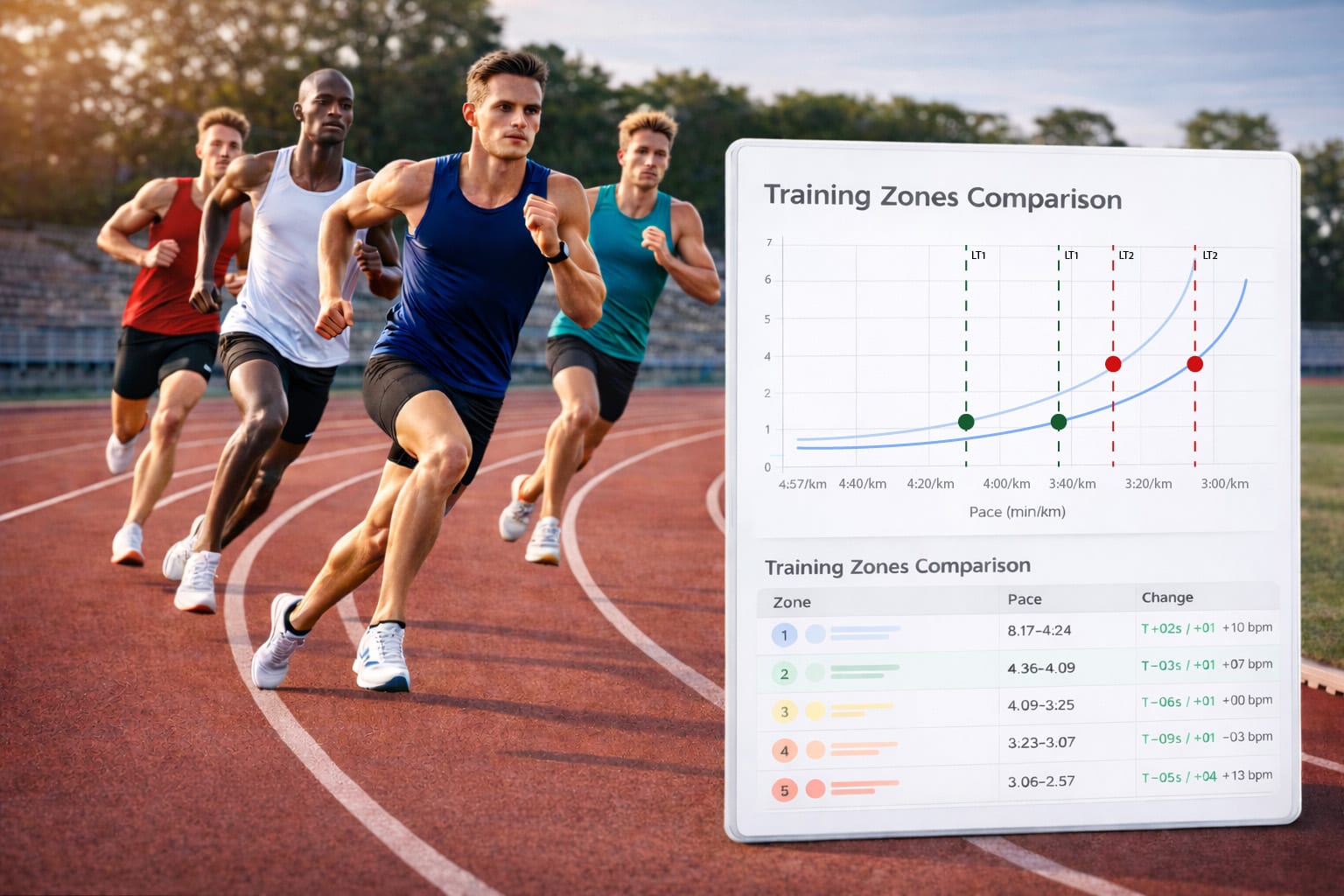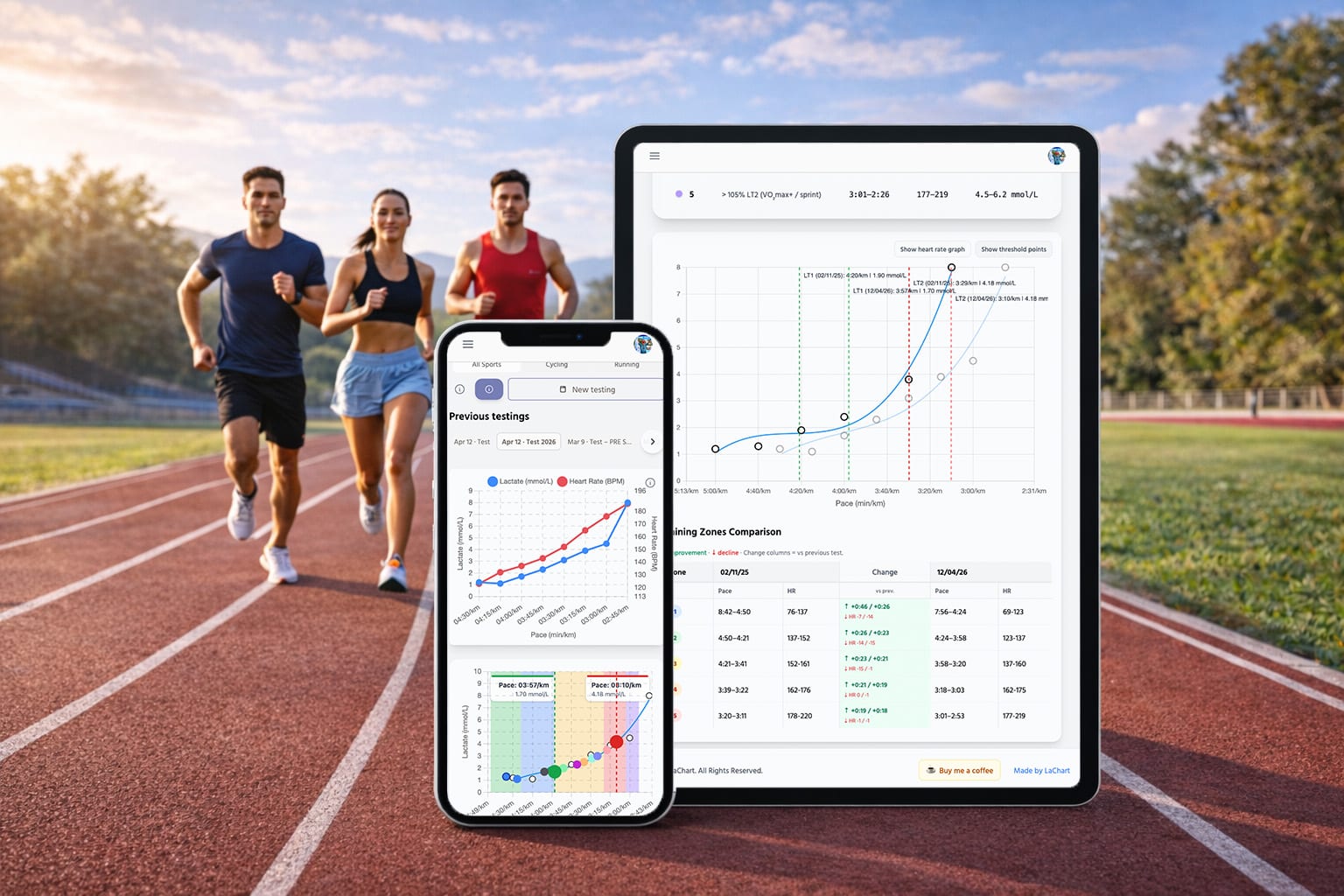
The Two Thresholds Every Endurance Athlete Has
Your body's energy systems don't switch on and off cleanly — they shift gradually as exercise intensity increases. But there are two critical inflection points where your physiology changes meaningfully:
- • Lactate first rises above baseline
- • ~1.5–2.2 mmol/L (cycling)
- • ~2.0–2.5 mmol/L (running)
- • Upper limit of true Zone 2
- • Fat metabolism still dominant
- • Sustainable for 4–8+ hours
- • Lactate accumulation accelerates
- • ~3.5–4.2 mmol/L
- • Equivalent to FTP (cycling)
- • Corresponds to MLSS
- • Carbohydrate-dominant
- • Sustainable for 45–75 minutes
The Physiology: What's Actually Happening
At LT1: The Aerobic System Reaches Its Ceiling
At rest and during very low-intensity exercise, your mitochondria can process lactate as fast as slow-twitch muscle fibres produce it. Net blood lactate stays stable — usually 0.8–1.2 mmol/L at rest.
As intensity increases, slow-twitch fibres produce more lactate, but your aerobic system continues to clear it efficiently. LT1 marks the highest intensity at which this balance is maintained. Cross it, and blood lactate begins rising in a gradual, manageable way. This is the onset of "tempo" effort — harder but still sustainable for long periods.
LT1 is closely correlated with the ventilatory threshold (VT1) — the point at which breathing rate first increases noticeably. Many athletes have heard coaches say "train at a pace where you can still hold a conversation." That's LT1.
At LT2: The System Can No Longer Keep Up
As intensity continues beyond LT1, more fast-twitch muscle fibres are recruited. These fibres produce lactate far faster than your aerobic system can clear it. LT2 is the highest exercise intensity at which lactate production and clearance remain balanced — the Maximal Lactate Steady State (MLSS).
Above LT2, lactate accumulates exponentially. Fatigue onset is rapid. A cyclist riding above their LT2 for a sustained period will experience progressive burning, slowing, and eventual inability to maintain power.
LT2 is the closest blood-based equivalent to the commonly used FTP (Functional Threshold Power). Research suggests FTP estimates approximate LT2 — though the relationship varies by individual and test protocol.
The "Grey Zone" Between LT1 and LT2
The intensity range between LT1 and LT2 — often called Zone 3 or "tempo" — is one of the most debated topics in endurance coaching. It is hard enough to cause meaningful fatigue and glycogen depletion, but not intense enough to drive the high-end adaptations of VO₂max work.
The polarised training principle
Elite endurance athletes typically distribute training as approximately 80% below LT1 (Zone 1–2), and 20% above LT2 (Zone 4–5). The Zone 3 grey zone between LT1 and LT2 is minimised. This "polarised" distribution produces better aerobic adaptations than spending most time in the middle-intensity zone — a common mistake among amateur athletes.
How LT1 and LT2 Define Your 5 Training Zones
Active recovery. Should feel effortless. Promotes blood flow and glycogen replenishment without adding training stress.
The most important training zone for aerobic development. Drives mitochondrial biogenesis and fat oxidation capacity. Should be the majority of training volume.
Comfortable discomfort. Good for race-specific fitness in events 2–5 hours long. Use sparingly in base phases.
The most potent single zone for improving sustainable power or pace. Intervals of 10–20 minutes at this intensity drive LT2 upward significantly.
Short, intense efforts. Drives VO₂max adaptations and neuromuscular power. Requires full recovery between sessions.
Why Heart Rate Zones Are Not Enough
Traditional heart rate zone calculators use percentages of maximum HR (e.g. Zone 2 = 60–70% HRmax). The problem: these percentages assume the same LT1 position for all athletes, which is physiologically wrong.
A well-trained cyclist may have LT1 at 78% of HRmax. An untrained person may threshold at 62%. Using the same percentage formula for both gives completely different training stimuli. Blood lactate testing removes this ambiguity — your zones are defined by your actual physiology, not a population average.
LaChart calculates HR at LT1 and LT2 directly from your test data (by interpolating HR at the threshold power), so you get accurate HR training zones based on your own threshold heart rates — not arbitrary percentages.
Sport-Specific Differences
| Sport | LT1 Unit | LT2 equivalent | Notes |
|---|---|---|---|
| Cycling | Watts (W) | FTP ≈ LT2 | Power meter gives most accurate threshold measurement |
| Running | sec/km or min/mile | Lactate threshold pace | LT2 ≈ ~1 h race pace for trained runners |
| Swimming | sec/100 m | CSS (Critical Swim Speed) | LT1 harder to detect due to technique effects |
| Rowing | Watts or split (sec/500m) | Similar to cycling | LT values tend to be higher absolute lactate than cycling |
How Training Shifts LT1 and LT2
Both thresholds are highly trainable. After a well-structured 8–12 week base training block:
- LT1 (in watts or pace) typically rises 5–15%
- LT2 typically rises 3–10%
- The ratio between LT1 and LT2 often narrows in elite athletes — their aerobic system is so developed that LT1 sits very close to LT2
This is why retesting every 8–10 weeks is recommended — your zones shift as you adapt, and training to outdated zones means training at the wrong intensity.