Ask most endurance athletes for their key lab number and they'll say VO2max. But two athletes with an identical VO2max can have wildly different thresholds, fuel use and race performance — and the reason is usually VLaMax. It's the number that explains why one rider is a time-trial diesel and another is a punchy sprinter, despite the same aerobic engine.
This article explains what VLaMax is, how it interacts with VO2max to set your lactate threshold, what value you actually want, and how to shift it.
What is VLaMax?
VLaMax is your maximal glycolytic rate — the fastest your body can produce lactate, measured in mmol/L per second. Where VO2max describes your aerobic ceiling, VLaMax describes your anaerobic (glycolytic) power: how hard and fast your muscles can break down carbohydrate for energy when oxygen alone can't keep up.
Neither number means much alone. It's the balance between your aerobic ceiling (VO2max) and your glycolytic rate (VLaMax) that determines the metabolic outcome that actually matters for endurance: where your lactate thresholds sit, and how much fat versus carbohydrate you burn.
Why VLaMax moves your lactate threshold
Your second lactate threshold (LT2) — the anaerobic threshold, close to FTP in cycling — is the point where lactate production outpaces clearance. VLaMax is one side of that equation:
- High VLaMax → LT2 shifts down. A strong glycolytic system pumps out lactate at lower intensities, so you hit the tipping point sooner. Great for repeated sprints, worse for a flat 40 km time trial.
- Low VLaMax → LT2 shifts up. Less lactate produced at a given intensity means a higher sustainable threshold and better fat oxidation — the profile of strong time-trialists and marathoners.
This is why chasing VO2max alone can disappoint: if your VLaMax is high for your event, your threshold — and your durable, race-winning power — stays capped no matter how big the aerobic engine gets. For how threshold relates to FTP, see FTP vs LT2; for the two thresholds themselves, see LT1 vs LT2 training zones.
What VLaMax do you actually want?
There's no universally good value — only one that fits your event. As a rough guide:
| Athlete / event | Target VLaMax | Why |
|---|---|---|
| Time-trial, marathon, long triathlon | Low (~0.3–0.4 mmol/L/s) | Higher LT2, spares glycogen, better fat use |
| All-rounder / road racer | Moderate (~0.4–0.5) | Balance of threshold and punch |
| Sprinter, track, criterium | High (0.6+) | Repeated explosive power |
A marathoner with a high VLaMax is fighting their own physiology; a track sprinter with a low one has no finishing kick. The goal is to move VLaMaxtoward what your event rewards.
How to lower VLaMax (the common goal)
Most endurance athletes want to lower VLaMax to raise their threshold. The levers:
- High-volume Zone 2. Lots of low-intensity aerobic work down-regulates glycolytic enzymes and builds fat oxidation. (See Zone 2 training.)
- Long, steady sessions. Duration at low intensity is the strongest driver.
- Occasional low-carb-availability training. Training some easy sessions with low glycogen nudges the body toward fat metabolism — use carefully.
- Less frequent short glycolytic sprint work during base phases, since repeated all-out efforts train the very system you're trying to quiet.
To raise VLaMax (sprinters), do the opposite: short maximal efforts, high-intensity glycolytic intervals, and adequate carbohydrate.
How VLaMax is measured
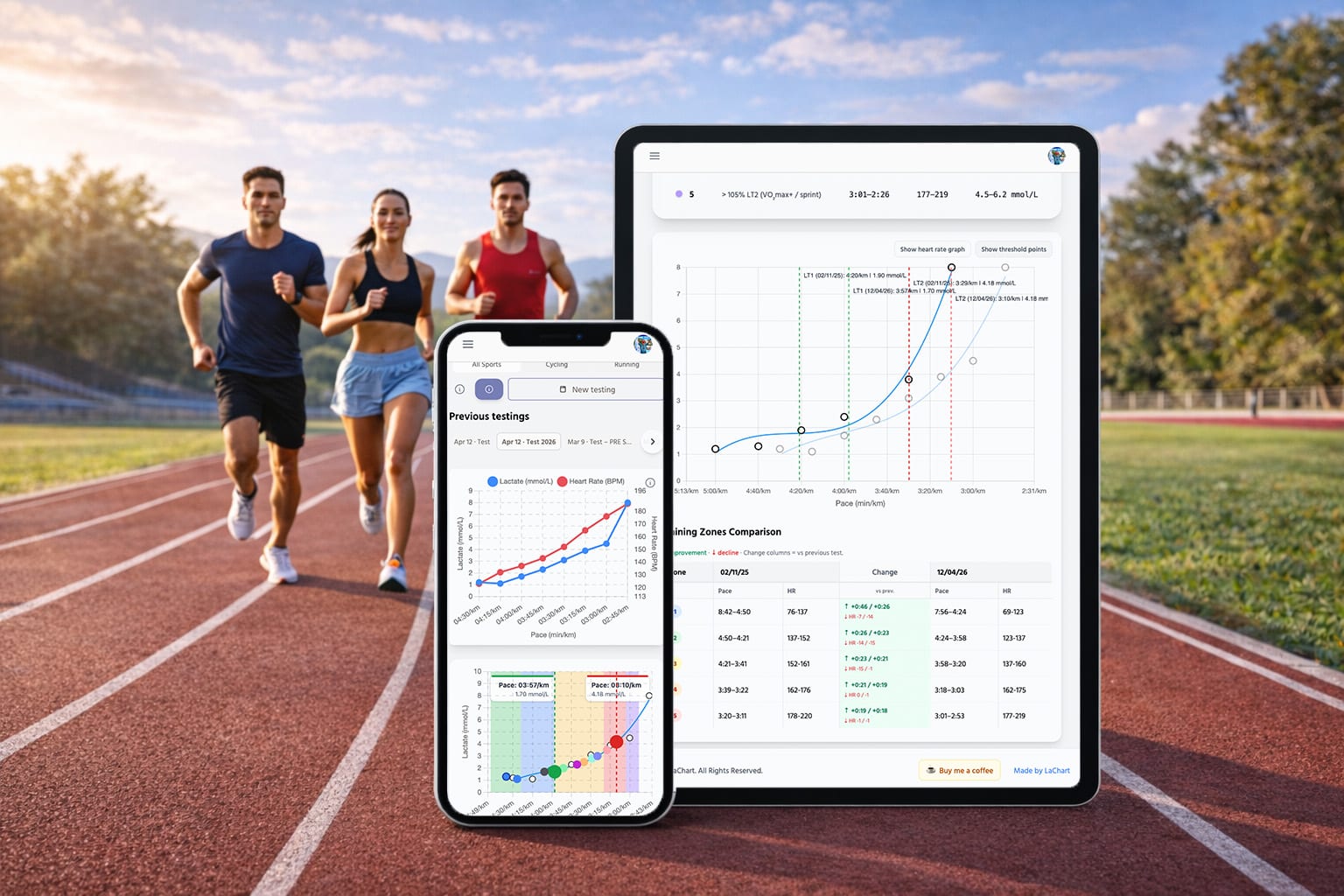
The direct test is a short (~15-second) all-out sprint with a blood-lactate sample before and immediately after (and a follow-up), timing how fast lactate accumulates and correcting for the alactic (creatine phosphate) phase at the start. VLaMax can also be estimated from a full lactate step test using physiological modelling — which is how LaChart surfaces it alongside your LT1, LT2 and zones, so you get the aerobic and glycolytic picture from the same session instead of a separate sprint test.
The bottom line
VO2max tells you how big your aerobic engine is; VLaMax tells you how the anaerobic system pushes against it — and together they set your threshold. For most endurance events, a lower VLaMax means a higher, more durable threshold, and you shift it there with aerobic volume, not more intervals. Measure both, know your profile, and train the number your event actually rewards.