Open three different training apps and each hands you a different "threshold" number to build your season on. One shows Critical Power, one shows FTP, and your heart-rate zones are anchored to LTHR. They're all trying to describe the same thing — the highest intensity you can sustain aerobically — but they measure it in different ways, land at slightly different values, and behave differently day to day.
Pick the wrong one, or treat them as interchangeable, and every zone you derive inherits the error. This article breaks down what each number actually is, how they line up, which is most accurate, and how a single lactate test settles the argument by giving you all three at once.
The three numbers, quickly
| Number | What it is | Units | How it's measured |
|---|---|---|---|
| Critical Power (CP) | The asymptote of your power-duration curve — the highest power your aerobic system can sustain in a steady state | Watts | Modelled from several maximal efforts of different durations |
| FTP | Functional Threshold Power — the power you could hold for ~1 hour | Watts | Usually 95% of a 20-minute test (or a ramp/8-min estimate) |
| LTHR | Lactate Threshold Heart Rate — the heart rate at your anaerobic threshold (LT2) | bpm | Lactate step test, or a 30-min field-test average |
Two of them (CP and FTP) are power numbers; one (LTHR) is a heart-rate number. That distinction matters more than most people realise — power and heart rate answer different questions, which we get to below.
Critical Power: the physiological asymptote
Critical Power comes from a simple, powerful idea: plot your best power for a range of durations — say 1, 3, 5 and 12 minutes — and the points fall on a curve that flattens toward a horizontal line. That line is your Critical Power: the boundary between efforts you can sustain in a metabolic steady state and efforts that inexorably drive you toward exhaustion.
The gap between your short-duration power and CP is your W′ ("W-prime") — a fixed battery of anaerobic work you can spend above CP before you blow up. This is CP's unique strength: it doesn't just give you a threshold, it quantifies how much you have above it, which is gold for pacing breakaways, climbs and time trials.
- Pros: physiologically grounded, modelled from multiple efforts so it's repeatable, and it comes with W′ for pacing.
- Cons: only as good as the test efforts you feed it — a poorly paced 3-minute or 12-minute effort skews the model. It's a power-only concept, so it says nothing about your heart rate or lactate directly.
FTP: the practical one-hour estimate
FTP is the number the cycling world actually runs on, because it's easy to test and every platform supports it. It's defined as the power you could hold for roughly an hour, and it's almost never tested that way — instead it's estimated, most commonly as 95% of your best 20-minute power, or from a ramp test.
That convenience is also its weakness. FTP is a single estimate inferred from one shorter effort, so it's sensitive to how you paced that test and to your particular physiology. A rider with a big anaerobic contribution can over-shoot a 20-minute test and end up with an FTP they can't actually hold for an hour. We cover exactly how FTP relates to the physiological threshold in FTP vs LT2.
- Pros: quick, universally supported, good enough for setting everyday training zones.
- Cons: least precise of the three; a 20-minute test is not an hour, and the 95% factor is a population average, not your average.
LTHR: the heart-rate anchor
LTHR is the heart rate at your lactate threshold — specifically LT2, the anaerobic threshold. Where CP and FTP tell you how hard to push, LTHR tells you how hard your body is working internally. It's the right anchor for heart-rate zones, especially for long endurance sessions where power alone can hide accumulating fatigue.
But heart rate is a slower, noisier signal. It lags at the start of intervals, drifts upward over a long ride (cardiac drift), and moves with heat, hydration, caffeine, sleep and stress. That's why LTHR is excellent for endurance and threshold zones but useless above threshold, where HR simply can't keep up with the effort. Full method and zone-building guide in Lactate Threshold Heart Rate.
How they line up (and why they don't match)
For a well-trained cyclist, the three tend to sit close together — but "close" is not "equal":
- CP is usually a few percent above FTP. Because CP is a steady-state asymptote and FTP is discounted from a 20-minute test, most riders' CP comes out slightly higher. Train off FTP and your threshold sessions may run a touch easy; train off CP and they may run a touch hard.
- LT2 (the true lactate threshold) can sit on either side. Depending on your glycolytic profile (your VLaMax), your measured LT2 power can be above or below both CP and FTP. This is the crux: CP and FTP are performance estimates; LT2 is a direct physiological measurement.
- LTHR is a heart rate, so it can't be compared in watts at all — it's the internal-load partner to whichever power number you use.
The practical consequence: if your FTP, CP and LTHR were each set from different tests on different days, your power zones and heart-rate zones may quietly disagree — and you'll feel it as sessions that are "in zone" on one metric but not the other.
Power or heart rate — which should drive the session?
This is the question underneath the whole comparison. The short answer:
- Use power (or running pace) as the primary target for intervals, threshold efforts and anything short. It responds instantly and isn't fooled by heat or fatigue.
- Use heart rate (anchored to LTHR) as the secondary signal, and as the primary one for long Zone 2 rides where internal load and drift matter more than hitting an exact wattage. See Zone 2 training.
- Watch the two together. When your heart rate at a fixed power starts climbing across a session, that's fatigue — useful information no single number gives you.
How a lactate test resolves all three
Here's the thing the CP-vs-FTP-vs-LTHR debate usually misses: they're all proxies for the same underlying physiology, and a blood lactate step test measures that physiology directly. In one test you record power (or pace) and heart rate and a lactate sample at each stage, which gives you:
- Your LT2 — the true anaerobic threshold in watts/pace, the number FTP and CP are trying to approximate.
- Your LTHR — the heart rate at that exact point, not a formula.
- Your LT1 and the top of Zone 2, which neither CP nor FTP gives you.
- Power, pace and heart-rate zones that all agree, because they came from the same effort on the same day.
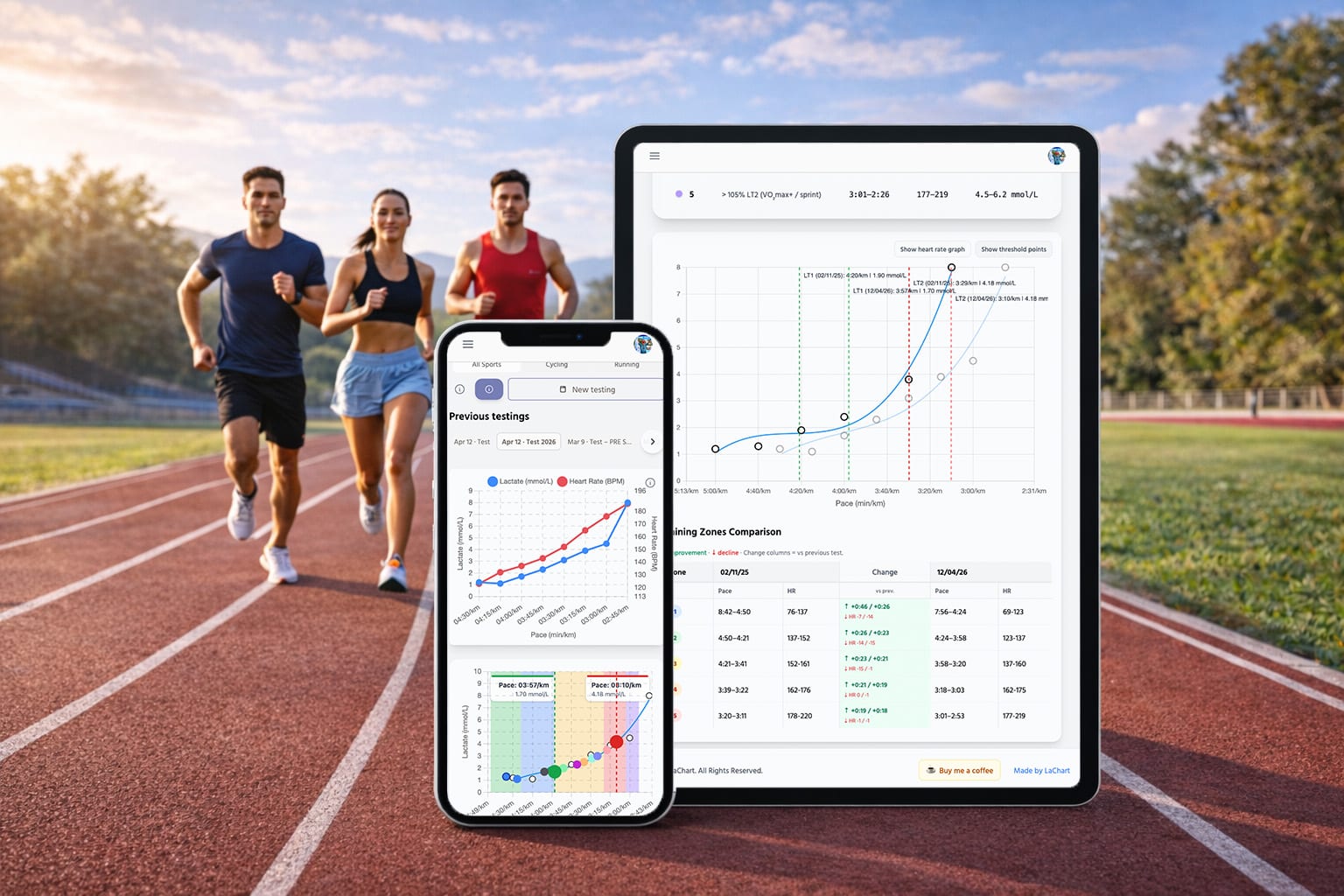
This is what LaChart automates: enter your step-test numbers — power/pace, heart rate and lactate at each stage — and it detects LT1 and LT2 with several methods at once, then reads out your threshold heart rate and builds matching power, pace and HR zones. Instead of three numbers from three tests that don't quite line up, you get one coherent picture. You can also start free with the lactate curve calculator to see your thresholds from a single test.
The bottom line
Critical Power, FTP and LTHR aren't rivals so much as three different windows onto your endurance ceiling. CP is the most robust power estimate and comes with W′ for pacing; FTP is the convenient everyday standard but the least precise; LTHR is the right anchor for heart-rate zones but a noisier signal. Train primarily off power, watch heart rate alongside it, and if you want the ground truth all three approximate, measure it once with a lactate test — then every zone below it is built on the same foundation.