Open any heart-rate training plan and it will tell you to spend so many minutes in Zone 3, so many at threshold, so many in Zone 5. But those zones are only as good as the number they're built on. If you set them from "220 minus age" or a percentage of your max heart rate, you're anchoring your whole plan to a population average that is probably wrong for you by 5–15 beats. The number that fixes this is your lactate threshold heart rate (LTHR).
This article explains what LTHR is, why it's a better anchor than max HR, the three ways to measure it (from most to least accurate), and how to turn it into heart-rate zones you can actually train by.
What is lactate threshold heart rate?
Your LTHR is the heart rate at your lactate threshold — the intensity above which blood lactate starts to accumulate faster than your body can clear it. In practice "the lactate threshold" that LTHR refers to is usually LT2, the anaerobic threshold — roughly the hardest effort you could hold for about an hour. It's the same physiological event that defines FTP in cycling, expressed as a heart rate instead of a power or pace.
There are really two threshold heart rates, and it's worth knowing both:
- LT1 heart rate (aerobic threshold) — the top of your easy, all-day endurance zone. This is the ceiling of Zone 2 training.
- LT2 heart rate (anaerobic threshold) — what most people mean by "LTHR", and the anchor for threshold and tempo work.
If the LT1/LT2 distinction is new, our guide to LT1 vs LT2 training zones lays out the full picture. For the rest of this article, "LTHR" means your LT2 heart rate unless stated otherwise.
Why LTHR beats "percentage of max heart rate"
Max-HR formulas and %HRmax zones fail for the same reason: they assume everyone's physiology sits in the same place relative to their maximum. They don't.
- Max HR itself is highly individual. Two 40-year-olds can have maximums 20+ bpm apart. "220 − age" has a standard error of around ±10–12 bpm — big enough to misplace every zone below it.
- The threshold sits at different %HRmax for different people. LT2 can fall anywhere from about 85% to 92% of max HR depending on training status. A single percentage can't capture that.
- LTHR moves with fitness in a way max HR doesn't. As you train, your max HR barely changes, but your threshold HR (and the power or pace you can hold there) climbs. Anchoring to LTHR means your zones track your fitness; anchoring to max HR means they don't.
This is why coaches and physiologists build heart-rate zones from a measured threshold, not from a birthday.
How to find your LTHR — three methods
1. Blood lactate step test (most accurate)
This is the gold standard because it measures the actual physiological event instead of inferring it. You ride or run a series of increasing stages, and at the end of each stage you record both your heart rate and a fingertip blood-lactate sample. Plot lactate against intensity, find the deflection point where lactate starts climbing sharply (LT2), and read off the heart rate at that point — that's your LTHR.
- Why it wins: it pins LT1 and LT2 directly, gives you the HR, power and pace at each, and it's repeatable so you can track change over time.
- Do it yourself: a portable analyzer makes this a home test — see our step-test protocol guide for stage length, sampling and the common mistakes, and the at-home guide for the kit.
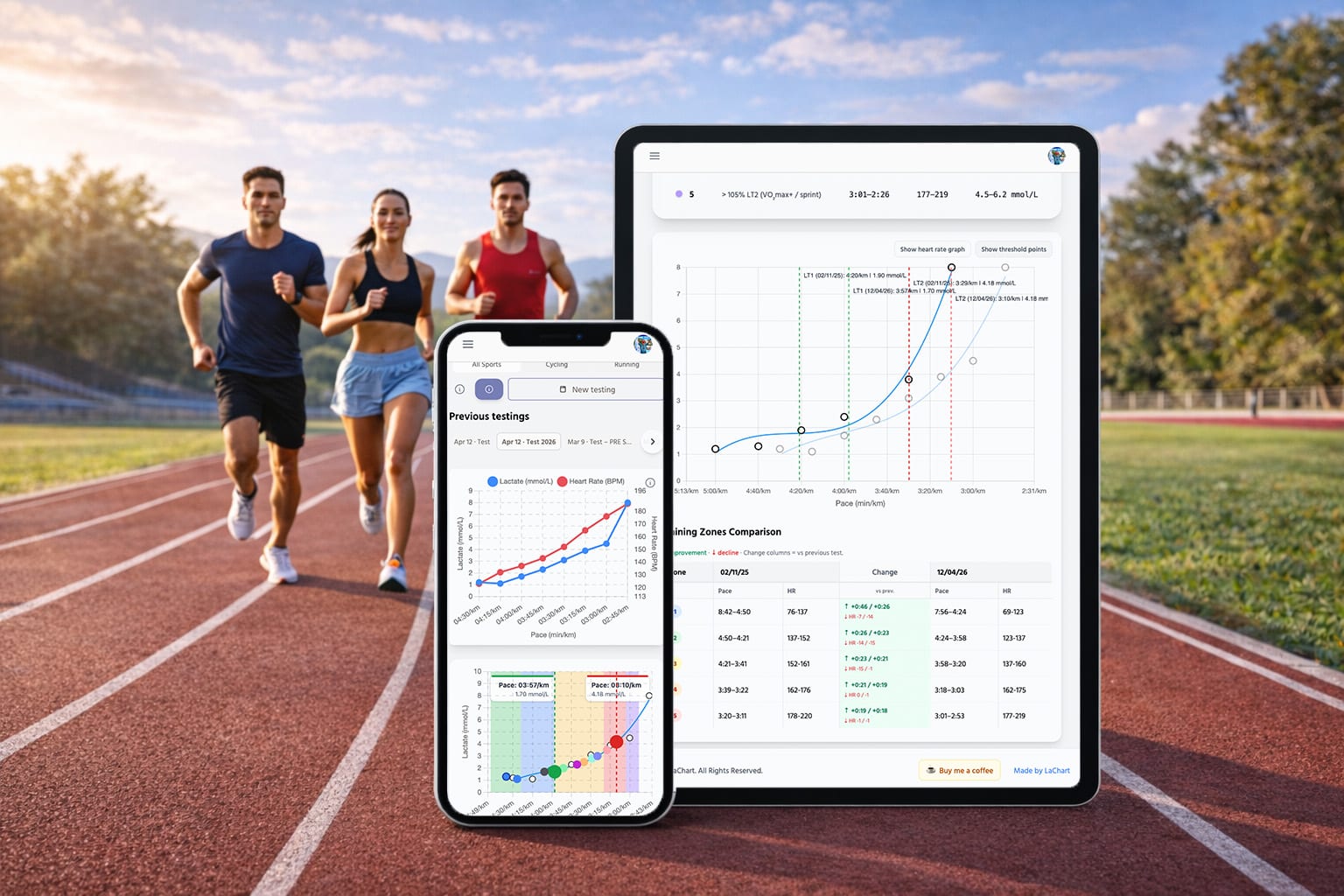
This is exactly what LaChart automates: enter your step-test numbers — including the heart rate at each stage — and it detects LT1 and LT2 using several methods at once, then reads out your threshold heart rate along with your full HR, power and pace zones. No manual curve-drawing.
2. Field test (good, no blood needed)
The most widely used field method comes from coach Joe Friel: do a 30-minute all-out time trial, solo, on a route or trainer where you can hold a steady effort. Start your lap timer at the 10-minute mark and take your average heart rate for the final 20 minutes — that average is a good estimate of your LTHR.
- Pros: free, no equipment beyond an HR strap, reasonably accurate for most people.
- Cons: pacing a true 30-minute effort is hard; go out too fast or too easy and the number is off. It estimates only LT2 — you don't get LT1 or your aerobic-threshold HR from it.
- Tip: use a chest-strap HR monitor, not a wrist optical sensor, for threshold work — optical HR lags and drops beats exactly when the effort is hard.
3. From an existing lactate test or race file
If you've done a lab or home lactate test before, you already have your LTHR — it's the heart rate recorded at LT2. You can also approximate it from a recent hard, steady effort of ~40–60 minutes (a hilly TT, a hard group ride you drove, a threshold race): the average HR of a well-paced hour is close to LTHR for most trained athletes.
Turning LTHR into heart-rate zones
Once you have your LTHR, you can build zones as percentages of it. A common scheme (adapted from Friel) looks like this — treat the numbers as a starting point, not gospel:
| Zone | % of LTHR | Purpose |
|---|---|---|
| Zone 1 — Recovery | < 85% | Active recovery, easy spinning |
| Zone 2 — Aerobic / endurance | 85–89% | Base, fat oxidation (near LT1) |
| Zone 3 — Tempo | 90–94% | Sustained moderate work |
| Zone 4 — Threshold | 95–99% | At/just under LTHR |
| Zone 5a — Just above threshold | 100–102% | Threshold overload |
| Zone 5b/5c — VO2max & anaerobic | > 102% (HR lags here) | Short, hard intervals |
The important caveat: above threshold, heart rate stops being a useful guide. In short VO2max and anaerobic intervals your HR can't rise fast enough to reflect the effort, so pace or power is the better target there — and LTHR-based zones are most useful from recovery up through threshold.
The limits of heart rate (and how to work around them)
LTHR is a great anchor, but heart rate is a noisy signal. Know its quirks so you don't get misled:
- Cardiac drift: over a long session your HR creeps up at the same power/pace as you fatigue and dehydrate. Don't chase a fixed HR late in a ride — you'll end up going too easy.
- Heat, altitude, caffeine, stress, illness all shift HR by several beats. Your LTHR isn't a fixed constant every single day.
- HR lags effort at the start of intervals and on short efforts — useless for anything under a few minutes.
- Best practice: anchor endurance and threshold work to LTHR, but pair it with power (bike) or pace (run) set from the same lactate test, so drift and daily noise don't push you into the wrong zone. See how power and threshold relate in FTP vs LT2.
The bottom line
Your lactate threshold heart rate is the most useful HR number you can know — but only if it's yours, measured, not guessed from your age. A blood lactate test gives it to you directly along with LT1, LT2 and your full zones; a 30-minute field test gets you close for free. Set your zones from LTHR, re-test as you get fitter, and pair heart rate with power or pace so you're training against your physiology instead of a formula.